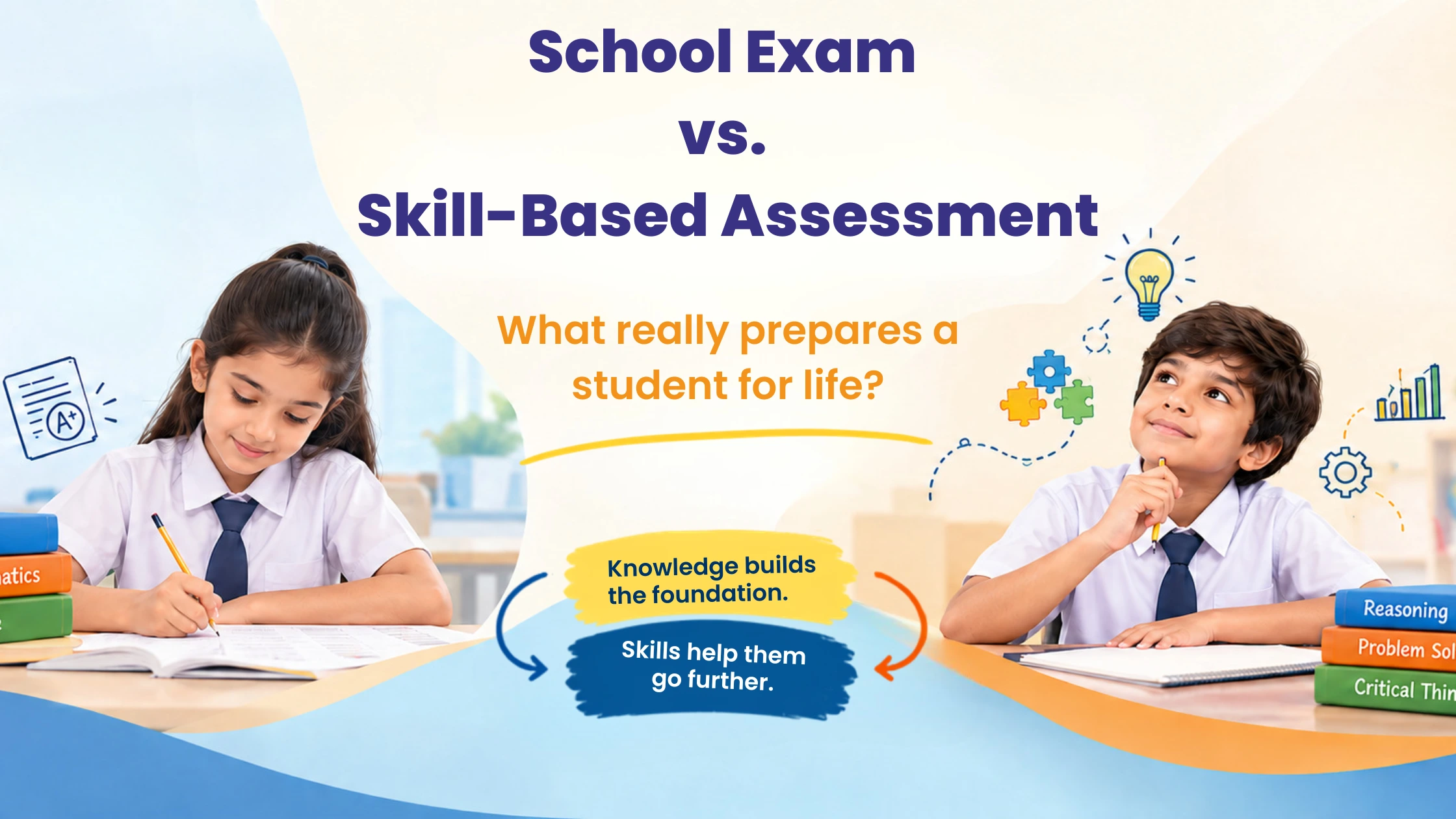
For decades, school exams have been one of the most familiar ways of understanding a student’s academic progress. They helped measure what students had learned, how well they understood their subjects, and how effectively they could demonstrate that knowledge in an examination. But learning does not stop at knowing the right answer.
As education continues to evolve, another question is becoming increasingly important: Can students use what they know when they face a new problem or situation?
And that is where skill-based assessment becomes important.
Imagine two students in the same classroom.
Riya performs consistently well in school exams. She understands her lessons, remembers important concepts, and scores good marks. Whereas her classmate Aman does not always perform as well in written tests, but he enjoys solving puzzles, identifying patterns, finding different ways to approach a problem, and explaining ideas in his own words.
Does this mean Riya is smarter than Aman?
No, they simply demonstrate different learning styles.
Which brings us to an important question: What is the difference between school exams and skill-based assessments?
Let’s Start with School Exams. What Do They Really Measure?
School exams, often referred to as traditional exams, are an important part of the education system. They are generally based on the curriculum taught in school and give us an idea of how well students understand their academic subjects.
Through exams, students demonstrate their understanding of concepts, answer questions, and show how prepared they are for the next stage of their academic journey. For teachers and parents, school assessment also offers a way to see how a student is progressing across different subjects.
Preparing for exams can help students develop valuable habits such as studying regularly, managing time, organising information, and working towards a goal.
However, a written examination usually gives us a snapshot of how a student performs in a particular setting. It does not always show how they approach an unfamiliar problem, connect different ideas, or use a concept in a new context.
That is where another form of student assessment can add value. One such approach is skill-based assessment.
What Is Skill-Based Assessment?
Skill-Based Assessment focuses on how students use their knowledge and skills to think, reason, and respond to different situations.
Instead of asking, “What does the student know?”, a skill-based assessment also looks at questions such as:
- Can the student apply a concept to an unfamiliar problem?
- Can they identify patterns and relationships?
- Can they analyse information before reaching a conclusion?
- Can they use logical reasoning to find an answer?
- Can they approach a problem in more than one way?
Of course, this does not mean that knowledge is less important. In fact, knowledge is the foundation on which these skills are built.
Skill-based assessment connects the two: what students know and how they use it.
So, How Is Skill-Based Assessment Different?
To understand traditional exams vs. skill-based assessment, think about what each one is asking a student to do.
School exams generally assess learning against a defined curriculum. Skill-based assessments focus more strongly on the student’s ability to apply that learning.
For example, a school exam asks a student to use a formula they have learned in class. A skill-based question puts that formula in a different context and requires the student to determine which concept or approach should be used.
The difference is not simply in the difficulty of the question. It is about the kind of thinking required to answer it.
What Can Skill-Based Assessment Help Students Develop?
One of the biggest benefits of skill-based assessments for students is that they encourage children to look at learning differently.
1. They encourage application
Instead of simply recalling a concept, students get opportunities to use it. This helps them see why they learned it and where it can be useful.
2. They develop higher-order thinking
When questions involve analysis, reasoning, comparison, interpretation, and problem-solving, students have to look beyond familiar textbook patterns and think things through.
3. They help identify strengths and areas for improvement
For students, skill-based assessment can highlight areas where a child feels confident, as well as skills that may need more practice.
4. They encourage students to approach unfamiliar problems
Not every problem in life will look like a question from a textbook. Giving students exposure to unfamiliar situations encourages them to think independently and explore different ways of reaching a solution.
5. They build awareness of learning beyond marks
Marks remain important, but they are not the only indicator of a student’s capabilities. When students understand the skills behind their performance, they also become more aware of how they learn, think, and solve problems.
Why Is Skill-Based Assessment Important for Students?
Think about the world children are preparing to enter. It will involve new technologies, unfamiliar situations, complex problems, teamwork, communication challenges, and decisions with no obvious answer.
Being able to understand information, think critically, solve problems, and adapt to new situations can help students navigate these challenges with greater confidence.
That is why skill-based assessments can complement regular school assessment. They give students another opportunity to develop skills that extend beyond what is measured through familiar exam formats.
So, How Do NELTAS International Competitions & Assessments Bring This Into Practice?
The NELTAS International Competitions & Assessments give students opportunities to explore and demonstrate subject-related skills in English, Maths, and Science.
Rather than limiting assessment to familiar textbook questions, the assessments encourage students to engage with questions that require them to think, reason, interpret, and apply what they have learned.
By bringing skill-based assessment into their learning journey, NELTAS Exams gives students the chance to go beyond familiar exam patterns and strengthen skills such as reasoning, problem-solving, comprehension, and application.
For parents and educators, this broader perspective can be useful too. A student’s performance is not just about the final score. Looking at the skills demonstrated during an assessment can provide meaningful insights into their learning journey.
What Really Prepares Students for Life?
School exams play an important role in building and measuring academic learning. But preparing students for the future takes more than knowing the right answers.
Students need knowledge to understand the world, along with the ability to question, analyse, solve, communicate, and adapt. This is why skill-based assessments are valuable. They add another dimension to learning by helping us understand how students use their knowledge beyond familiar questions and situations.
And that is what makes skill-based assessment an important part of a student’s learning journey. It helps turn learning into something students can carry with them beyond the classroom.
So, what really prepares students for life? It is not just knowing the answers, but having the knowledge and skills to face what comes next.